Tuesday, February 14, 2006

240 Days of Housing Inventory Stats in Sacramento

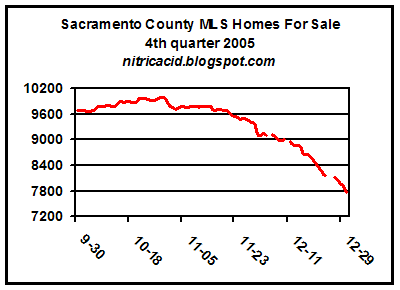
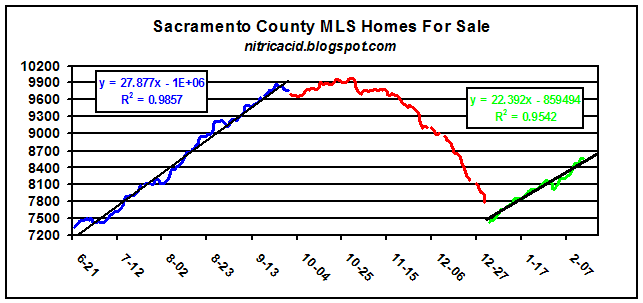
After following some of the discussions on Patrick’s Blog among others, I thought I’d post a follow-up to my October housing stat post. During November and December 2005, the number of new listings fell 25% from 9986 on October 30 to 7439 on January 1:

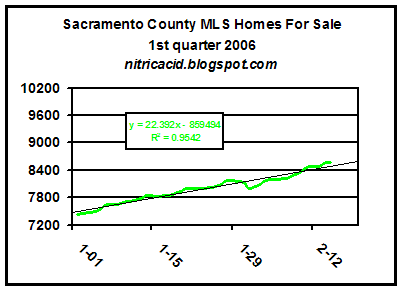
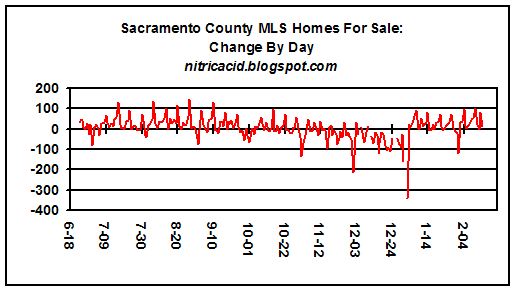
This trend culminated with a drop of 340 listings over the New Years holiday. However, the trend is now reversing dramatically, and the number of new listings has shot back up to 8554 as of this writing:
Here are some trends I’ve observed:

At the end of each month, there is a large decrease in inventory. I’ve read in other places that MLS listing will drop automatically after 30, 60, or 90 days, depending on what the listing agent chooses.

There is an inventory jump (almost) every Saturday, with a bigger one on the first Saturday of the month. Obviously, the agents want to get their listing in for weekend open houses, and they might wait a week before re-listing a property that was automatically dropped.

The trend we are seeing now in Sacramento is similar to the one we saw last summer. After a big drop in inventory last Fall, we are averaging an inventory gain of over 22 houses per day the start of 2006.

If the trend continues, we’ll surpass the 2005 inventory high by mid-May, and we’ll pass the all-time inventory record for Sacramento of 13507 in 1993 sometime in October. (My numbers don’t always jive with OCRenter’s because I don’t include El Dorado or Yolo in my numbers.) However, there are signs that new listings are accelerating here. Since February 1, the number of new listings has gone up by over 550, which averages to 39 per day.

The listings in the south area, including the New-Home-Mecca of Elk Grove, are increasing much more rapidly than in the north area (which has less new developments.) Over the last year, there has averaged around 150 more listings in the north part of the county, but this trend has suddenly reversed, with the south area now showing 20 more listings than the north:
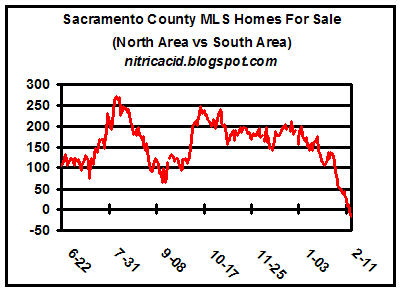
Since February 1, there were 327 new listings in the south, and 196 in the north. Only “speculating” at this point, but the massive discounts announced by Centex among others might be scaring Elk Grove investors into selling now rather than later.
References:

http://bubbletracking.blogspot.com/2006/02/tracking-sacramento-metro.html http://patrick.net/wp/ http://www.sacbee.com/content/homes/resale/ http://www.centexhomes.com/Sacramento/norcal12hoursale.asp?DivisionID=1016 http://www.benengebreth.org/housingtracker/

Sunday, November 06, 2005

Using Audacity Recording Software to Find Bullet Velocity at Various Distances

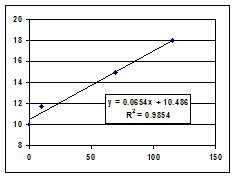
Part 1: Proof of Concept By Max and Phildog http://nitricacid.blogspot.com pdf version October 27, 2005 By using audio recording software such as Audacity, it should be possible to calculate the speed of bullets fired at metal targets by measuring the time it takes the sound of impact to reach the microphone after the bullet has been fired. This would be useful as both a basic chronograph, and for ballistics studies of various bullet shapes. Since we had a weekend free, we decided to give the idea a test run. This was our first attempt, and it was intended strictly as a proof of concept. Like all good first experiments, we found two things we did wrong for each thing we did right. The idea was simple. Since the speed of sound through air is dependent only on temperature, we should be able to record the sound of a bullet impacting on a metal target at a known distance, and subtract the time it took the sound of impact to travel back, to get the speed of a bullet over the distance. All we needed were some big chucks of metal, a good private shooting range, a tape measure, and a recording platform.

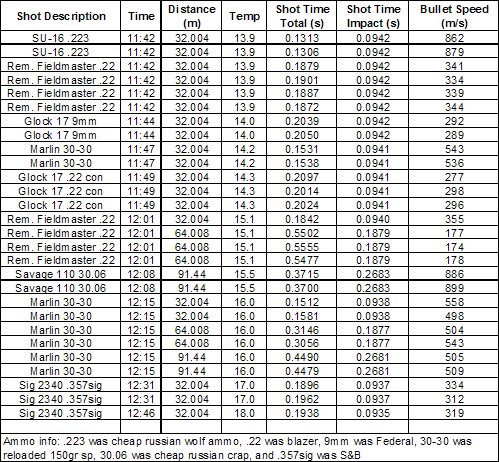
The white, blue, and black barrels holding the plates are 35, 70 and 100 yards away, respectively. Audacity is a full-featured open-source audio recording software. It came in especially handy for our experiment since it features a spectral waveform analysis tool that helped us tease out the impact sounds from other reflected sounds on the range. Here is the waveform and spectrum from a Marlin 30-30 lever action rifle impacting the first metal plate 35 yards away: Here's an mp3 of the sound. The bullet’s ringing impact on the metal plate is heard clearly and is discerned in the spectrogram by the persistence of audio peaks at certain frequencies as the ringing trails off. The other peaks in the spectrogram are echoes of the shot and impact bouncing off other objects in the field. Using the select feature in Audacity, it is possible to zoom in and measure the precise instant the bullet left the barrel, and when the impact sound returned to the microphone. For the above example, a time of 0.1575 seconds was recorded. Now, a word about the speed of sound. According to Wikipedia, the speed of sound in air varies only with temperature according to this formula: Speed (m/s) = 331.5 + 0.6*Temp(°C) So for our purposes, the flight time of the bullet would be the total time minus the time it took the sound to come back from the target. We then divide the distance by the flight time: Bs = Dtarget /(Ttotal – (Dtarget / (331.5+0.6*°C))) where Bs is the speed of the bullet, Dtarget is the distance to the target, and Ttotal is the total time from when the gun was fired and the impact was heard. Since we were at a high altitude on a clear, sunny day, the air temperature was changing during the experiment. Since we didn’t have a thermometer with us, we got weather station data from Mesowest and built a temperature curve: The only thing left to do was to listen to all the recordings and get the impact times. Here’s a table of our final results: A copy of the whole spreadsheet is available at the bottom. Conclusion Obviously, we have a lot of work to do. The first challenge, of course, is finding a private range. Since we were shooting with friends, it was tough to keep the whole range quiet while we ran our experiment. Another thing we discovered was larger targets make for louder impacts. It also might be easier to bring a small digital voice recorder to the range instead of a laptop, and do the math at a later time. We did show that by through a simple recording technique, it is possible to find the speed of bullets at short and long distances. References Excel Spreadsheet of above calculations Audacity Wikipedia Mesowest